

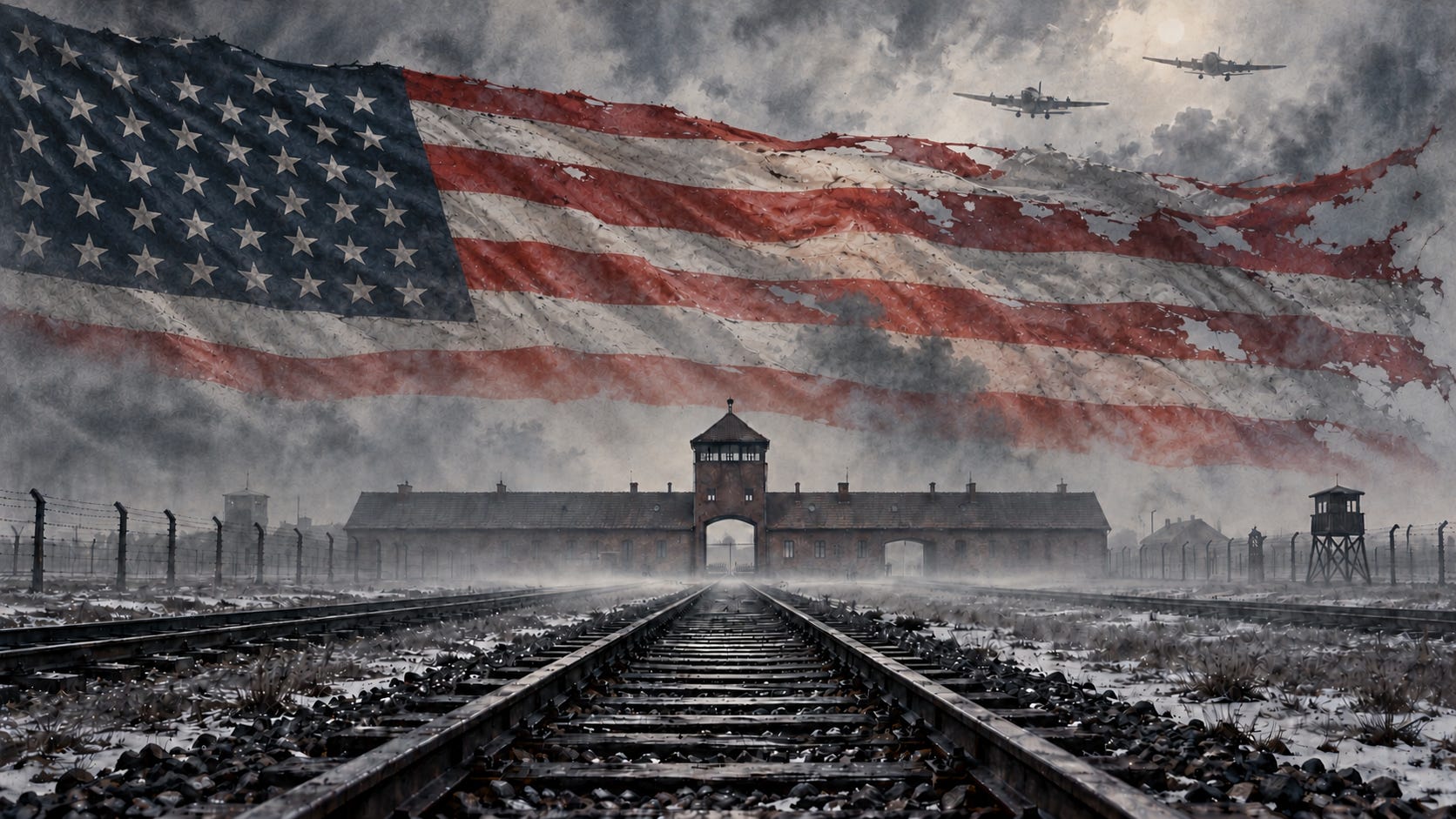
Three days after the publication of Savior and Seducer, I received my first negative review. More are sure to follow as writers at establishment media outlets find out about the book’s central arguments, especially those concerning American intervention in World War II.
But the first attack came from an unexpected source: CounterPunch, long co-edited by the late and great Alexander Cockburn, one of the last truly independent minds on the left and often the only socialist who agreed with me about the modern left’s fascistic tendencies and its enthusiasm for imperial war.
Joshua Sperber’s energetic critique of Savior and Seducer follows the curious practice of reformulating my arguments and then refuting them. In the book’s World War II chapters, which Sperber finds particularly objectionable, I argue that American policy under Franklin Roosevelt transformed two regional wars, one in eastern Europe and the other in eastern Asia, into a global conflict that killed more than sixty-five million people. I also argue that American intervention ensured the fulfillment of the Holocaust.
I’ve long expected these claims to draw the fiercest attacks because they challenge the central article of American faith, the belief that U.S. military intervention against Hitler and the Nazis was necessary to save the world from a still greater catastrophe. I’m disappointed, once again, to see an institution of the radical left rally to the establishment’s defense.
Like other defenders of the official American narrative of World War II, Sperber portrays Hitler’s territorial ambitions as limitless, citing his occupation of the rest of Czechoslovakia after promising to stop at the Sudetenland and his invasion of Poland far beyond the territories Germany had ceded to Poland after the First World War. He then misrepresents my argument as the claim that “if only Hitler had been given Danzig the war would have been averted.”
Yet much of the book’s discussion of World War II is devoted to Hitler’s ideology, which always included commitment to conquering all of Poland and western Russia for Lebensraum (“living space”). He claimed these territories as part of a “Greater Germany” once inhabited by Teutonic peoples whom he regarded as ancestors of modern Germans. This was racial imperialism, to be sure. But as I also show, it was an imperialism that ended in eastern Europe.
Hitler had for decades written and spoken extensively about his lack of interest in colonies outside Greater Germany, hoped for an alliance with Britain and the United States, and, according to virtually every historian of the Third Reich, invaded the West in the spring of 1940 only as a defensive measure to secure Germany’s western flank before advancing eastward.
The claim that Hitler intended to conquer the world and that we’d “all be speaking German” if the U.S. hadn’t intervened against him is instantly belied by the largely unknown fact that in 1939, when Germany began its conquest of the East, the Nazi Wehrmacht possessed not a single long-range bomber or a single landing craft capable of landing troops on foreign shores.
Sperber also somehow imagines that I place the decision to exterminate Jews under the Third Reich only after the formal U.S. declaration of war on Germany in December 1941. My actual argument, developed over many pages that Sperber appears to have skipped, is that the decision came sometime after it became clear that Roosevelt was headed for war with Germany. This could have been as early as March 1941, when Lend-Lease authorized massive shipments of American armaments to Germany’s enemies and made the United States a belligerent in all but name, or after the Atlantic Charter in August, when Roosevelt and Churchill declared their commitment to “the final destruction of the Nazi tyranny.”
I think October is the most likely date. As I document in detail, that was the month when Hitler prohibited Jewish emigration, expanded deportations from Reich cities into the occupied east, and began preparing Chelmno and other new death camps for extermination by gas. These developments preceded the formal U.S. declaration of war but followed months of escalating American involvement that was tantamount to war.
Remarkably, toward the end of the review, Sperber acknowledges in passing that the United States under Roosevelt “was hypocritically complicit in the genocide insofar as it adamantly refused to permit refugees to enter the US.” That is one half of my Holocaust argument, and it bears directly on the other. The Nazis had long pursued a policy of forcing Jews out of Germany. Tens of thousands were moved by the German government to Shanghai and Palestine, while Nazi officials had also proposed mass deportation to Madagascar. Hitler had repeatedly demanded that the United States and other Western countries accept German Jews, even offering to transport them on German ships, but those countries maintained severe restrictions on Jewish immigration.
American moves toward war through 1941 eliminated the Jews’ usefulness to Hitler as hostages against intervention while immigration restrictions blocked their escape. Whether the extermination decision came in the spring or fall of that year, I interpret this reversal of the emigration policy as a response to America’s de facto entry into the war. This is the basis for my argument that the six million would have lived had the United States stayed out of the war.
This account of America’s role in World War II must contend with a national myth taught even to the most radical Americans, the belief that their country’s greatest act of heroism was its defeat of Nazism.